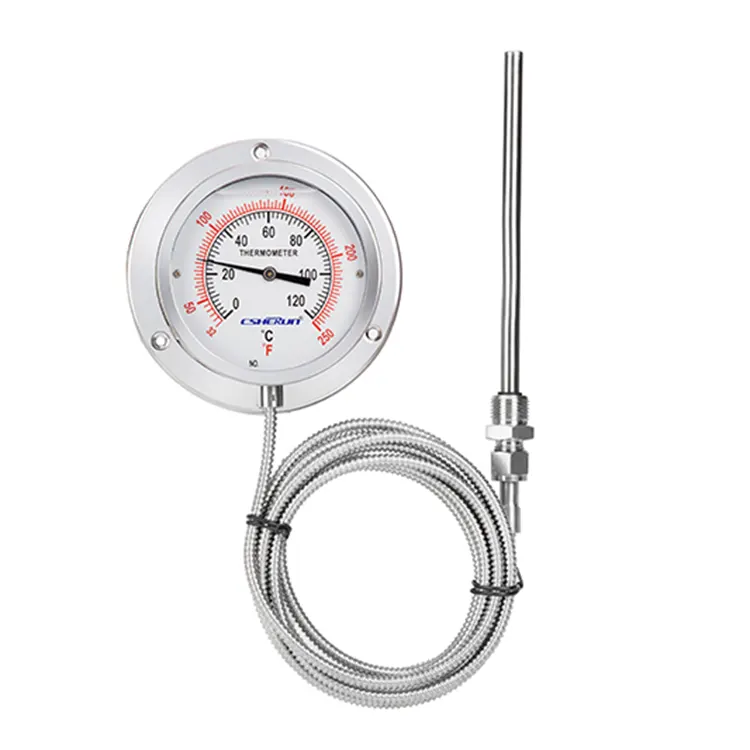
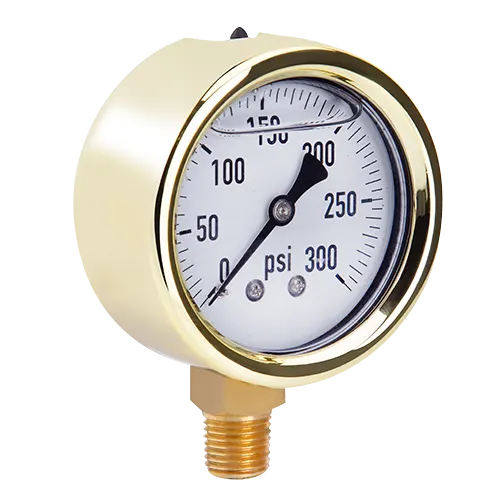
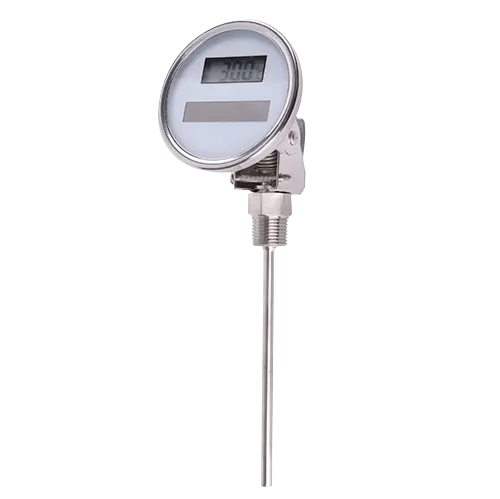
Bimetal Thermometer is an instrument for measuring temperature based on the principle of thermal expansion and contraction, and is widely used in the industrial field. Its working principle is based on the characteristics of solid expansion due to heat. By welding two metal sheets with significantly different linear expansion coefficients together, a bimetallic temperature sensing element is formed. When the temperature changes, due to the difference in the linear expansion coefficients of the two metals, the bimetallic strip will bend and deform, thereby driving the pointer to rotate, and finally displaying the corresponding temperature on the dial. Due to its unique properties, the bimetallic thermometer performs particularly well in the medium and low temperature range of -80℃ to 500℃. It is intuitive and easy to read, has good mechanical strength, is corrosion-resistant and vibration-resistant, safe and reliable, and is strong and durable.
Bimetal Thermometers not only have a variety of structural forms to meet different measurement needs, but are also equipped with a wealth of technical parameters to ensure the accuracy of measurement. For example, its accuracy levels are divided into 0.25, 0.5, 1.0 and 1.5. Industrial thermometers often use 1.5, while precision measurements recommend 0.5 or 0.25. In addition, the thermal response time of bimetallic thermometers usually does not exceed 40 seconds, and the protection level reaches IP55, which can meet the measurement needs in a variety of complex environments. In the fields of petrochemical, chemical, industrial and commercial, bimetallic thermometers are widely used and are often used to display the medium temperature in process pipelines and equipment on site.
Bimetal Thermometer can be classified in many ways. According to the connection direction of the pointer disk and the protective tube, they can be divided into three types: axial, radial and universal; according to the different installation and fixing methods, they can be divided into movable external threads, fixed threads, ferrule threads, ferrule flanges and fixed flanges. These different types of bimetallic thermometers have their own characteristics and can meet the needs of users in different application scenarios. In general, as a common temperature measuring instrument, bimetallic thermometers play an important role in industrial production and scientific research with their unique temperature measurement principle, superior performance and diverse structural forms.